

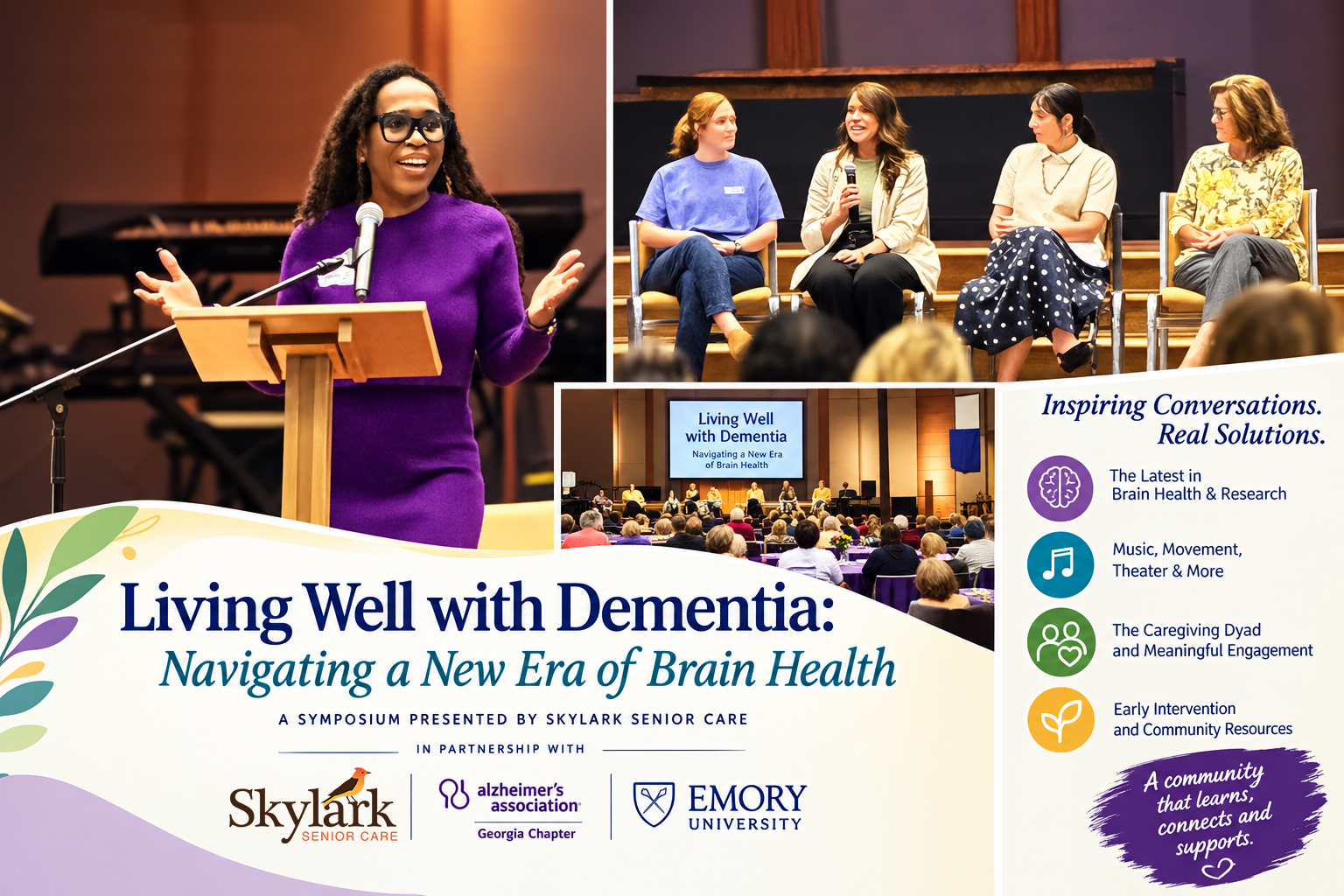
If you weren’t at Johns Creek United Methodist Church on September 24, you missed more than a presentation—you missed a room full of people discovering that the conversation around dementia is changing.
Neighbors, families, caregivers, healthcare professionals and community leaders gathered for Living Well with Dementia: Navigating a New Era of Brain Health, presented by Skylark Senior Care in partnership with the Alzheimer’s Association Georgia Chapter and Emory University.
And judging by the conversations throughout the room, people came ready to learn—and left with plenty to think about.
A New Era of Brain Health
One of the most important messages of the day was that there really are new developments in the way we understand and approach Alzheimer’s disease.
Dr. Kalisha Bonds Johnson, PhD, RN, PMHNP-BC, highlighted several developments that would have seemed almost unimaginable not long ago.
Earlier answers are becoming possible.
In 2025, the first blood test to help detect Alzheimer’s disease became available, offering a less invasive way to help identify the disease than traditional approaches such as brain scans or spinal taps.
That matters because earlier detection can create opportunities for earlier conversations, planning and intervention.
Treatments are beginning to target the disease itself.
There are now two therapies that can slow the progression of Alzheimer’s disease itself rather than simply treating its symptoms.
There is an important reality check, however: these treatments are not cures, their benefits are modest, and they are intended for people in the early stages of Alzheimer’s disease. They also do not currently address every form of dementia.
And access remains a challenge. Cost, referrals and delayed diagnosis can prevent some families from benefiting from these advances.
Still, the message was encouraging:
Something is changing.
And knowing what is changing—and when to act—matters.
Living Well in Real Life
The symposium wasn’t simply about medicine and science.
In fact, some of the most memorable conversations centered on something much more human: how we continue to live meaningful lives while navigating cognitive change.
The panel, “Living Well in Real Life,” was moderated by Jill Disney of the Alzheimer’s Association and featured Tracy Moon and Megan Nare of the Charlie and Harriet Shaffer Cognitive Empowerment Program, neurologic music therapist Kenzie Taylor, and Robert Hindsman of the Alliance Theatre.
Members of the Alzheimer’s Association Early-Stage Program also shared their lived experiences.
Together, they explored something families sometimes overlook:
Living well with dementia isn’t only about what someone can no longer do. It’s also about discovering what they can still enjoy, experience and contribute.
Movement.
Music.
Theater.
Storytelling.
Relationships.
Connection.
These aren’t simply pleasant distractions. They can become meaningful ways for people living with dementia to remain engaged with the world around them.
Meaningful Engagement Doesn’t Have to Be Complicated
Cloud Q. Conrad’s presentation on “Essential Traits of the Caregiving Dyad: Meaningful Engagement for Living Well With Dementia” offered another important perspective.
Meaningful engagement doesn’t have to mean completing a project, accomplishing a task or checking something off a list.
It could be watching a movie.
Sitting outside and listening to birds.
Listening to music.
Sharing a story.
Taking a walk.
Or simply being together.
The goal isn’t necessarily to produce something.
The goal is to provide an experience that offers value, encourages interest, appropriately engages skills and—perhaps most importantly—provides choice and a sense of control.
That’s a powerful shift in perspective for caregivers.
Sometimes, Caregiving Means Saying “Yes, And…”
One of the most thought-provoking ideas from Conrad’s presentation was the importance of understanding that a person’s experience of the world may change as dementia progresses.
Their reality may not always match ours.
That doesn’t necessarily mean they are “wrong.”
For caregivers, learning to respond flexibly—to meet a person where they are and build from there—can create more enjoyable interactions and help establish trust.
Think of it as taking the “yes, and…” approach.
Instead of immediately correcting or redirecting, consider joining the person’s experience and finding a way forward together.
That simple change can transform an interaction from a confrontation into a connection.
Supporting Both People in the Caregiving Partnership
Cloud Q. Conrad also addressed the caregiving dyad—the relationship between the person living with dementia and the person providing care.
That’s an important distinction.
Dementia doesn’t affect just one person.
It affects relationships, routines, responsibilities and the emotional landscape of an entire care partnership.
Supporting the person with dementia is essential.
Supporting the caregiver is essential, too.
When both people in the partnership have access to meaningful engagement, resources, education and support, the entire caregiving experience can change.
Don’t Wait Until You Need Help
Skylark gerontologist Mary Caldwell closed the event by discussing the importance of early intervention, including Skylark’s new early-stage program and adult day health services.
And that may be one of the biggest takeaways from the entire symposium:
You don’t have to wait for a crisis to get connected.
Learning about resources early gives families time to explore their options, ask questions and discover programs that may support both the person living with dementia and the people who love them.
The earlier the conversation begins, the more opportunities there may be to create a plan that fits the family’s needs.
If You Missed It…
We wish you could have been in the room.
Not simply because of the information—but because of the energy, connection and sense of possibility that filled the room.
People came together because dementia touches families in different ways. Some came looking for answers. Some came looking for resources. Some came because they are already providing care. And some simply wanted to understand more.
They found something else, too:
A community willing to have the conversation.
At Skylark Senior Care, we believe that living well with dementia involves more than managing symptoms. It involves finding connection, purpose, engagement and support—and helping families discover those possibilities as early as possible.
The conversation doesn’t end when the symposium ends.
In many ways, it’s just beginning.
Stay Connected With Skylark
Whether you’re caring for someone today, beginning to notice changes, or simply want to understand more about brain health and dementia, don’t wait until you need an answer to start looking for resources.
Learn. Connect. Ask questions. Explore what’s available.
Because a new era of brain health isn’t just about new tests and treatments.
It’s about creating more opportunities for people living with dementia—and the people who care for them—to live well.